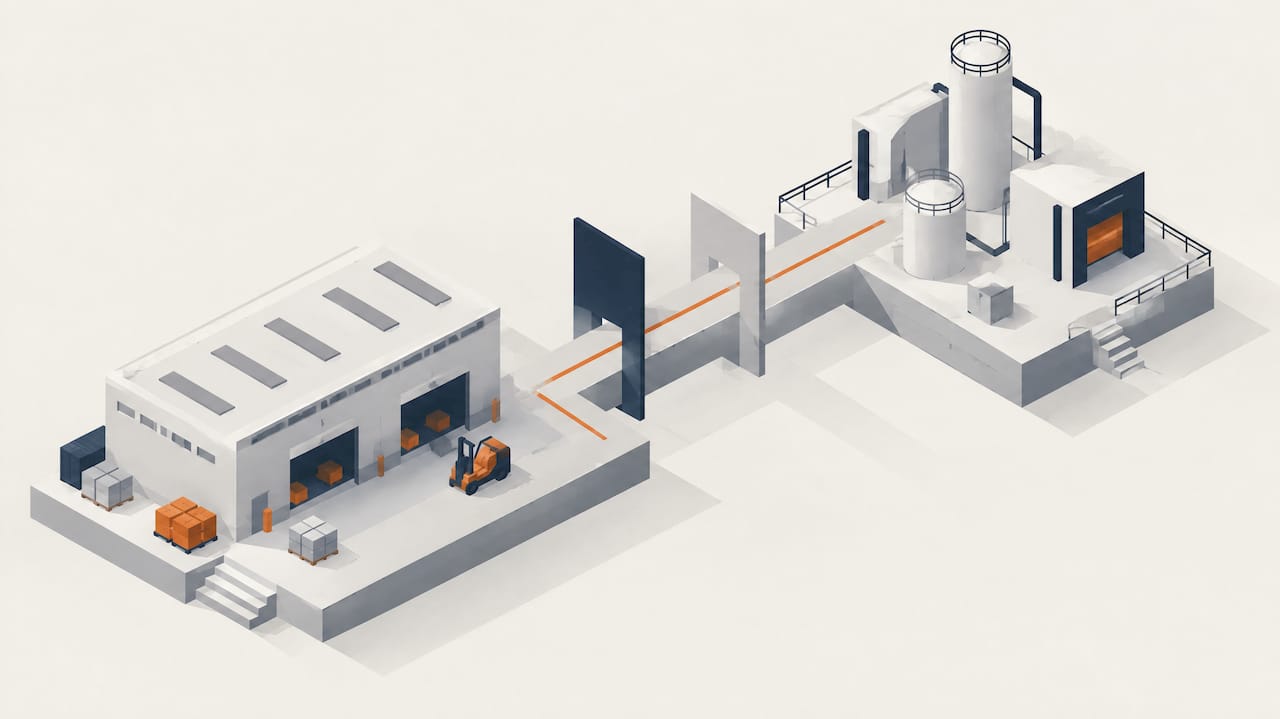
An industrial two-way radio is only as good as the system around it. The handset matters, but coverage, licensing, repeaters, interference and integration with alarms decide whether a crew or site team can be heard when it counts. The most reliable route is to survey the vessel or site first, specify the system around what the survey finds, and have the same team licence, install and support it. That is how we work at OLAS Communications, and it is the approach this guide follows. It covers the system types, the questions to ask for a yacht, a construction site or an aerospace facility, and the UK licensing rules.
TL;DR
- Industrial radio is a system of handsets, repeaters, base stations and sometimes dispatch, not just a handset purchase.
- Beyond line of sight at VHF and UHF, you need a relay or repeater network to stay reliable, which is why coverage is surveyed rather than guessed.
- In the UK, most business radio systems need an Ofcom licence. Light licences cost £75 for five years, and larger or more complex systems are priced on their technical details.
- Digital standards such as DMR and TETRA suit larger crews and sites. Mixing manufacturers needs careful specification.
- We start with an RF survey, stay vendor-agnostic, and handle licensing, installation and ongoing support.
Table of Contents
- What makes a two-way radio industrial
- The main types of industrial radio system
- How the parts work together
- How far will an industrial radio reach?
- Specifying for your environment
- Interoperability: making equipment work together
- Licensing industrial radios in the UK
- Why survey before you buy
- Beyond voice: alarms, call buttons and cellular
- What we supply and support
- Keeping the system reliable over time
- FAQ
- Sources
What makes a two-way radio industrial
A consumer walkie-talkie works on licence-exempt channels, shares them with everyone nearby and has limited power. An industrial or professional system is built for a defined job: a captain talking to a deck crew through steel bulkheads, a site manager coordinating cranes across a building plot, or a ramp team working around aircraft.
Three things separate the two. Professional radios run on licensed or purpose-assigned frequencies, so your traffic is not competing with a neighbour's. They are built for harsh handling, with ingress protection, noise-tolerant audio and long battery life. And they sit inside a designed system: repeaters, fixed stations, group calling, emergency buttons and links to other equipment.
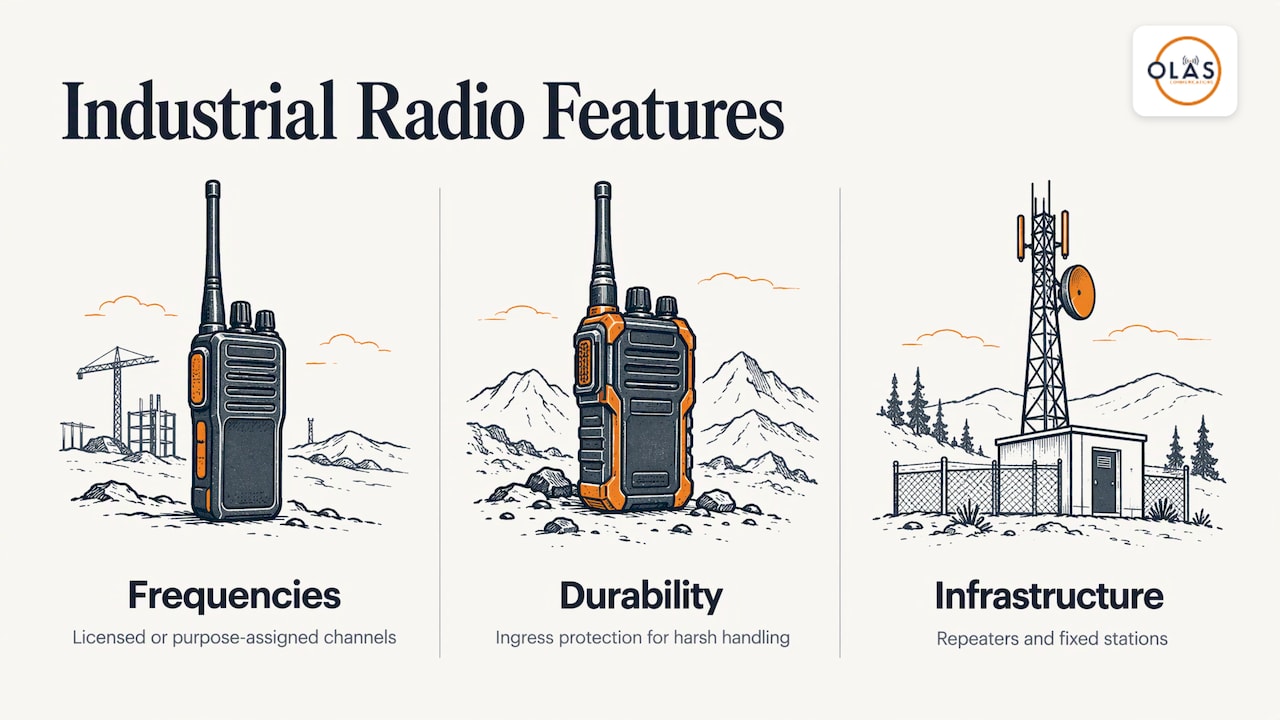
That last point is where most disappointment starts. A handset bought off the shelf may be excellent, yet fail in the engine room or on the third floor of a half-built block because nobody checked the radio environment first.
The main types of industrial radio system
Industrial systems differ in how radios connect to one another and how many users they support. Plant Engineering's overview of plant radio systems describes the main families: simplex (radios talk directly to each other), half-duplex and duplex operation, conventional and repeater systems, multisite networks, analogue and digital, and trunked systems.
In plain terms:
- Direct (simplex) radio. Handsets talk straight to one another. It is simple and has no infrastructure, but range depends on the terrain and the building.
- Repeater systems. A repeater receives a signal and retransmits it, usually from a high or central point. The U.S. Fire Administration's voice radio guide explains that repeaters listen and transmit at the same time on two frequencies, and that placing one at an elevated site can often double a portable radio's range.
- Digital systems (DMR). Digital mobile radio carries voice and data in a digital format, and supports groups, individual calls, text and location features. It is a common step up from analogue for mixed crews.
- Trunked systems (including TETRA). Trunking shares a pool of channels automatically between many users. Plant Engineering notes that talk groups let departments such as maintenance, security and production share the system without crowding each other. TETRA is a digital trunked standard used widely by emergency services and transport operators, according to ITA Group's overview of professional mobile radio.
Which one fits depends on the number of users, the area, the need for data and alarms, and how the radio must work with other systems. For yachts, we cover the differences between the two main digital standards in our guide to choosing DMR or TETRA for superyachts.
How the parts work together
A complete system usually has four layers.
- Handheld and mobile radios. Handhelds are carried by people. Mobiles are fixed in vehicles, plant or the bridge.
- Base stations. The U.S. Fire Administration describes these as fixed, mains-powered units with higher performance than portables, used for a control point or office.
- Repeaters. These extend coverage as described above, and linked repeaters add coverage and redundancy.
- Dispatch and control. A console lets a dispatcher operate base stations and repeaters and handle several radios at once, with headset and footswitch operation. Where several receivers cover one area, a voter system compares them and routes the cleanest audio to the dispatcher.
On a construction site this might mean a handful of handhelds, a repeater on the site cabin or crane, and a base station in the site office. On a superyacht it might mean dozens of handhelds, repeaters or distributed antennas below deck, and a link to the alarm system. Each added layer solves a problem, but also needs to be designed so that it does not create another one.
How far will an industrial radio reach?
There is no single honest range figure. The advertised range for a handset assumes a clear path. In real working environments, steel hulls, concrete floors, plant, trees and hills cut it sharply.
The ITU's emergency telecommunications handbook states that at VHF and UHF, some form of relay system or network is required for reliable communication beyond line of sight. That is the practical rule behind every coverage plan: if the radios cannot see each other, or the building gets in the way, you need infrastructure.
It is also why the same radio can be perfect in a yard and poor inside a steel-framed building or a vessel. The only reliable way to know is to measure the actual place, which is what an RF survey does.
Specifying for your environment
Yachts and commercial vessels
A vessel is a sealed metal box with many compartments. Signals that work on deck can vanish in a lower deck corridor or the engine room. Crew need clear channels for deck, engineering, interior and security, and many owners also want guest and crew cellular coverage onboard.
Points to settle at specification:
- Which bands suit the vessel, UHF for most onboard work and VHF where longer outdoor reach matters. Our marine UHF and VHF radio systems page sets this out.
- Whether the crew size and the need for groups, data or location justify DMR or TETRA. See our page on marine DMR systems.
- How the system handles interference from other onboard electronics and nearby vessels. We deal with this in our post on UHF interference on yachts.
- Whether coverage is delivered through repeaters or a distributed antenna system (DAS), which spreads signal through antennas placed around the structure. Our marine DAS page covers this.
For superyacht TETRA and DMR systems, we combine our survey-led approach with authorised DAMM system-partner expertise.
Construction sites
Sites change shape weekly. A radio plan that works at groundworks may fail at fit-out, once floors, cores and cladding are in. Specification should cover:
- Handheld count by trade and shift, and whether groups are needed so that crane, groundworks and logistics teams do not talk over each other.
- Whether a site-wide repeater is needed, and where it can be mounted and powered.
- Coverage inside the building as it rises. Our in-building coverage and DAS service addresses this for completed and in-progress structures.
- Battery life across the longest shift, and charging arrangements.
- Short-term and long-term supply, along with licensing and support.
Aerospace and airside operations
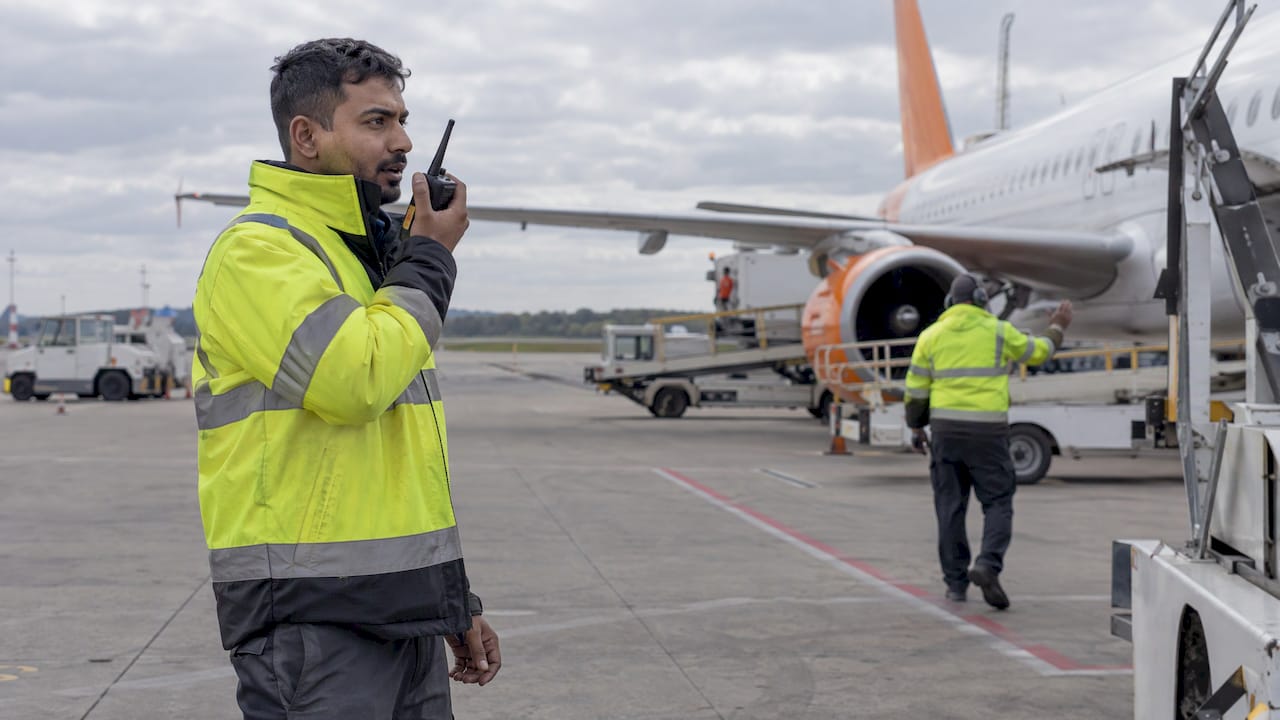
Here the priorities are dependable, clear audio in noisy hangars and ramps, strict channel discipline and equipment suited to the operating environment. The same principles apply: define the operational areas, measure the radio environment, then choose the system. Because the site rules are specific, requirements should be agreed in a survey and design stage rather than assumed from a product sheet.
Interoperability: making equipment work together
Mixed equipment is common, and it is where hidden faults appear. The U.S. Fire Administration warns that a common digital standard such as P25 does not by itself guarantee interoperability. A radio from a different manufacturer may not have full functionality on another maker's trunked system, so the combination has to be thoroughly tested.
The ITU handbook makes the wider point: being able to talk directly with the other organisations you work with, without intermediaries, avoids delay and misinterpretation. For a shipyard, a port or a site shared by several contractors, this is a design requirement from the start.
Being vendor-agnostic helps here. Because we are not tied to one manufacturer, the system is specified around your vessel or site and the equipment that suits it, not around a catalogue.
Licensing industrial radios in the UK
Most professional radio systems in the UK need a licence from Ofcom, the communications regulator. The licence gives you assigned frequencies and a legal basis for using them. Ofcom's business radio licence pages describe the main types:
- Simple UK: for handheld or mobile radios anywhere in the UK, with no base stations and a maximum power of 5 watts.
- Simple Site: for a base station and mobiles within an area of 1 kilometre or less.
- Technically Assigned and Area Defined: for larger or more complex requirements.
According to Ofcom's fees page, the light licences (Simple UK, Simple Site and Suppliers Light) cost £75 for five years. Technically Assigned and Area Defined fees depend on the technical details, such as location, frequency band and coverage. Check Ofcom's pages for the fee that applies when you apply, as fees can change.
Marine and aviation radio have their own rules, and the licence depends on the vessel and equipment. Radio equipment used on board a vessel is handled separately from land-based business radio, so confirm the route for your vessel at the specification stage. Licensing is part of what we provide, so it does not need to be a separate project for you.
Why survey before you buy
A survey replaces assumptions with measurements. For a vessel or building, the RF survey records where signal is strong, where it drops, which sources of interference are present, and where repeaters or antennas can physically go. The design then follows the findings: equipment, antenna positions, cable routes, power and the licence required.
A typical engineering sequence looks like this:
- Brief. Who needs to talk to whom, where, and with what other systems (alarms, cellular, crew call).
- RF survey. Measure the vessel or site and note constraints.
- Design and specification. Select equipment and layout, and agree the licence route.
- Licensing. Prepare and submit the required applications.
- Installation and commissioning. Fit, programme and test against the design.
- Support. Maintenance, repair and troubleshooting once the system is in use.
Our engineering process follows this sequence, from survey to licensing, installation and ongoing support, so one team stays accountable for the whole system.
Beyond voice: alarms, call buttons and cellular
Industrial radio rarely stands alone. Alarms need to reach the right person wherever they are, crew need a way to call for help, and guests or staff need mobile coverage.
Our TALOS alarm handler is designed to route alarms to radios and phones, and our Wi-Fi crew call buttons start from £650. On vessels, onboard cellular coverage can be designed alongside the radio system. Planning these together at the survey stage avoids retrofitting later. Details are on our TALOS CORE page and crew call buttons page.
What we supply and support
We supply, survey, design, licence, install, maintain and repair two-way radio systems, including UHF/VHF, DMR, TETRA and LTE radios, repeaters, and passive or active DAS for vessels and buildings. We also supply handheld and mobile radios, and body cameras.
If you are planning a system for a yacht, a construction project or an operational facility, our two-way radio solutions page covers supply and installation, plus repair and support. You can also contact us through the OLAS Communications site to discuss a survey.

Keeping the system reliable over time
Radio systems change as the vessel is refitted, the site grows or the crew expands. Batteries age, antennas get damaged, and new onboard or on-site equipment can add interference. Planned maintenance and quick troubleshooting keep the system dependable. Because the design records stay with the team that built it, faults can be traced against the original survey rather than diagnosed from scratch.
A useful habit is to review coverage after any major change: a new deck layout, an additional floor, a new contractor or new equipment on the same bands. A change in the radio environment is the point at which a system that worked last year can start to fail.
FAQ
How far can an industrial two-way radio go?
On a clear line of sight, handhelds can cover long distances, but buildings, hulls, hills and trees reduce that sharply. The ITU notes that at VHF and UHF you need a relay or repeater network for reliable communication beyond line of sight. A survey tells you the real figure for your site.
Do I need a licence for industrial two-way radios in the UK?
Most professional business radio systems do. Ofcom issues business radio licences, and the light licences cost £75 for five years, while more complex systems are priced on their technical details. Vessel radio follows separate marine rules. We handle licensing as part of a system project.
Should I choose DMR or TETRA?
Both are digital standards that suit larger crews and sites. The right choice depends on user numbers, coverage area, data needs and what the system must connect to. Our guides on DMR for yachts and DMR versus TETRA explain the differences.
Can I mix radios from different manufacturers?
Often yes, but the U.S. Fire Administration warns that sharing a digital standard does not guarantee full functionality across makers on a trunked system. Combinations need to be tested, so we specify them as part of the design.
Sources
- Basics of plant radio systems, Plant Engineering
- Professional mobile radio, ITA Group
- Voice Radio Communications Guide for the Fire Service, U.S. Fire Administration
- Emergency telecommunications handbook, ITU-D
- Business radio licence management, Ofcom
- Business radio licensing fees and payment, Ofcom